RequestOps – Waiting On & Follow-ups for Jira

See what's left on every request, and who it's waiting on.

Follow-ups, customer reminders, waiting-on tracking and SLA views for Jira Service Management and Jira, in one place.

Get it on Atlassian Marketplace Try it here On the Atlassian Marketplace
Free up to 10 users30-day free trialOne plan, everything includedBuilt on Atlassian ForgeNo calls outside Atlassian

What's left

See what's left and who it's waiting on

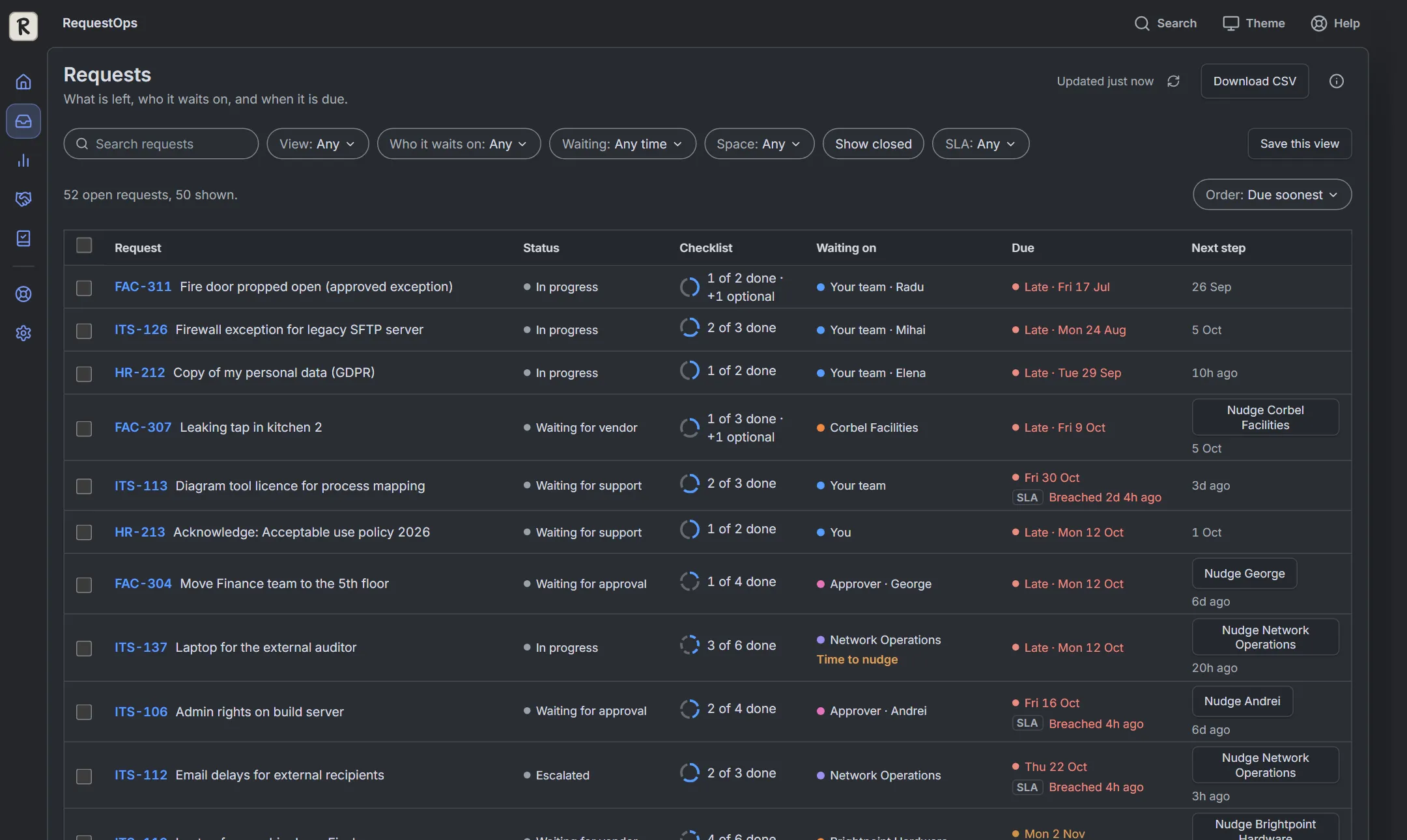
Every request shows its checklist and its current holder, and since when: the customer, an approver, another team, a vendor or your team. It shows in the panel on each request, on queues and in the Requests list.

  • Items tick themselves from Jira facts: fields, approvals, linked work, replies and attachments
  • Items reopen if the facts change
  • Approvers can approve or decline right in the request

Ask and Nudge

Ask or Nudge in one click, with Undo

Ask the customer for exactly what is missing, or Nudge a person or team about their part. You see the message first. Every send waits about 10 seconds so you can undo it.

  • Ask posts a plain public reply drafted from the open checklist items
  • On Jira Service Management a Nudge is an internal note; on plain Jira the preview tells you it is a public comment
  • Optional follow-ups and automatic closing stay off until an administrator turns them on

For managers

Show managers where request time goes

Insights shows what share of request time is spent waiting on others, and on whom, week by week. The SLA view uses your Jira SLA data to show what has breached or is about to, with who each request is waiting on.

  • Flow, workload and a monthly service review
  • Export to PDF, Excel or CSV
  • States a lower bound when history is incomplete

Up and running in minutes

  1. 1

    Install and pick a space

    Open RequestOps from Jira and choose a space to start with.

  2. 2

    Turn on a checklist

    Review the suggested checklist, or start from a template, and turn it on.

  3. 3

    See who has each request

    Requests show what's left and who they're waiting on. The first 90 days are worked out for you.

  4. 4

    Ask, Nudge, review

    Ask the customer or Nudge the right person. Managers open Insights.

Try it here. It's the real app.

RequestOps running with sample data. Take the 30-second tour, or click around yourself.RequestOps running with sample data. Open it and tap around. Nothing is saved or sent.

Open the app
RequestOps Requests list with sample data: every request, its checklist progress, who it is waiting on and when it is due.

The real app with sample data. Nothing is saved or sent.

Where the time goes

Every hand-over is recorded: to the customer, an approver, a vendor, another team, and back. So when someone asks why it took a week, the answer is already there.

How Insights adds it up
Sample request

Free calculator

Waiting is the cost nobody puts on the invoice.

Every request that sits with a customer, an approver, another team or a vendor costs someone time. Put in your own numbers and see what it adds up to in a year.

Work out your cost of waiting

Example result

€144,000a year

Your teamWaiting on someone else

200 requests a month, open 3 days on average, 35% of that time waiting on someone else, €10 per hour of waiting.

Also included

One price, everything included. No editions, nothing held back for a higher tier.

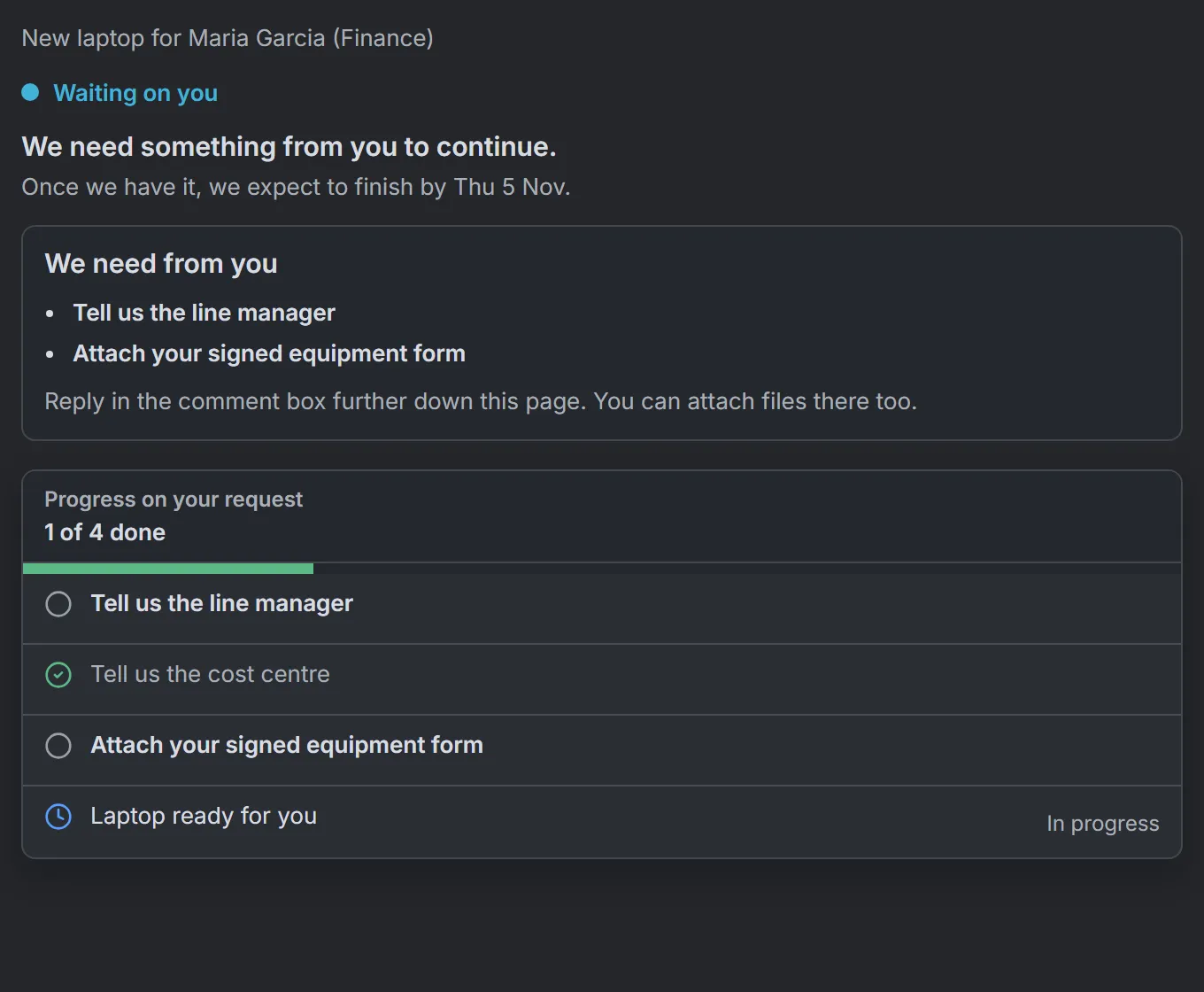
Customer portal: the request shows what is still needed from the customer and its progress.

Customers see in plain words what you still need from them, and nothing internal.

  • A Waiting on page for everything held by customers, approvers, other teams or vendors
  • Checklist templates and a gallery; import from other checklist apps
  • Journeys for multi-step work such as onboarding
  • Waiting views in the Requests list, on queue columns and in JQL
  • Teams, approvers with cover when someone is away, and vendors with one-click response links
  • Optional follow-ups and automatic closing, off until an admin chooses the rules
  • Review campaigns, deadline clocks and recurring requests
  • A dashboard gadget, Automation actions and an optional Rovo agent
  • Per-person motion and display settings

Pricing

Free for sites with up to 10 users. From 11 users, one plan with everything included, priced per user and billed through Atlassian Marketplace. 30-day free trial.

$149per month
$1,490 per year if billed annually

About $1.49 per user per month

Start the 30-day free trial
Price per user per month, for sites with 11 or more users
UsersPer user per month
Sites with up to 10 users in totalFree
Users 1 to 100$1.49
Users 101 to 250$1.00
Users 251 to 1,000$0.60
Users 1,001 to 2,500$0.23
Every user above 2,500$0.20

From 11 users you pay for every user, starting with the first. Each band of users is charged at its own rate. For example, 250 users cost 100 × $1.49 + 150 × $1.00 = $299 a month. The annual price is 10 times the monthly price, so $2,990 a year. Prices in US dollars, before tax. Atlassian Marketplace shows the exact price for your site.

Built on Atlassian. Your data stays there.

RequestOps runs on Atlassian Forge, makes no calls to servers outside Atlassian, collects no telemetry and follows Jira permissions. Jira administrators can download and erase a person's stored data from Settings.

Good to know

  • It shows who a request is waiting on based on your rules and Jira data. It can be wrong where statuses do not say who holds the request, and you can correct a rule at any time.
  • It does not guarantee that a customer, vendor or team receives, reads or answers a message.
  • It does not replace Jira SLAs, queues or Automation; it works with them.
  • It is not a compliance tool and not a legal record. No certification is claimed.

Works with Jira Cloud and Jira Service Management Cloud. Some features need Service Management: the portal view, approvals and SLA data.

Guides for service desks

Free toolCalculator · 1 min

What does waiting cost your service desk?

Put in your own numbers and see the yearly cost of waiting on customers, approvers, other teams and vendors.

Open the calculator

Guide6 min read

Who is this Jira request waiting on? Another team's next step

When a Jira Service Management request is stuck on another team's task, here's how to find who has the next step, nudge them where they work, and follow up.

Read

Explainer7 min read

Waiting time vs SLA time in Jira Service Management

Why a request can take 28 hours but show 4 hours on the SLA clock, and how to read waiting time and SLA time side by side without drawing the wrong conclusion.

Read

Guide8 min read

Customer follow-ups and auto-close in Jira Service Management

Set up customer reminders in Jira Service Management that stop when the customer replies, plus a safe auto-close. Step by step with Automation, and an app option.

Read

Templates6 min read

Customer follow-up message templates for Jira Service Management

Eight copyable Jira Service Management messages: ask customers for missing details and files, follow up, give a last call, and brief colleagues internally.

Read

Guide6 min read

Monthly service review for Jira Service Management: agenda and template

Run a 30-minute monthly service review in Jira Service Management: which numbers to use, how to read them honestly, and how to leave with owners and dates.

Read

Comparison7 min read

JSM Automation vs RequestOps for customer follow-ups

Customer follow-ups built with Jira Service Management Automation and with RequestOps, compared on one scenario, including when native is the better choice.

Read

Questions

Does it work with plain Jira, or only Jira Service Management?

Both. The portal view, approvals and SLA data need Jira Service Management. On plain Jira, checklists, waiting views and Nudges work; a Nudge posts a short public comment instead of an internal note, and the preview says which.

Will it message my customers without asking?

No. An agent previews and sends each Ask, with a 10-second Undo. Automatic follow-ups and automatic closing are off until an administrator turns them on and picks the spaces.

Does the customer get an email?

Jira sends its usual notification when a public reply is posted. Jira emails only customers whose address it can notify, so RequestOps cannot promise delivery.

Who can see which names?

Customers see only what your team shares with them. Names of customers, vendors and people are not shown to other parties.

Where is my data?

In Atlassian Forge storage and in your Jira site. RequestOps makes no calls to servers outside Atlassian and collects no telemetry.

What does it cost?

Free up to 10 users, then one plan priced by your Jira user count, with a 30-day free trial. No separate editions.

What happens if I uninstall?

Access ends. Jira comments, tasks and request properties RequestOps created stay in Jira; Atlassian manages retained app storage under its platform policy.

Can I bring checklists from another app?

Yes. Settings, Import reads Smart Checklist, Checklists for Jira and others, and shows a preview first. Nothing is deleted from the old app.

How do I get help?

Email support@unitlane.net, Monday to Friday, 09:00 to 17:00 Central European Time. You get a first reply within 1 business day, security reports included. Help is also built into the app.


Know who every request is waiting on.

Free up to 10 users. 30-day free trial for bigger sites.

Also from Unitlane Apps: Seatwise: find the Jira licenses nobody uses and handle leaversBunlings: estimation and retros your team will actually enjoy.